Will the Lord Allowed His Children to See the Garden of Eden Again

Adam and Eve, according to the creation myth of the Abrahamic religions,[i] [2] were the kickoff homo and woman. They are central to the belief that humanity is in essence a single family unit, with everyone descended from a single pair of original ancestors.[3] They also provide the basis for the doctrines of the autumn of man and original sin that are of import beliefs in Christianity, although non held in Judaism or Islam.[4]
In the Volume of Genesis of the Hebrew Bible, capacity ane through 5, there are two creation narratives with two distinct perspectives. In the first, Adam and Eve are non named. Instead, God created humankind in God's image and instructed them to multiply and to be stewards over everything else that God had made. In the second narrative, God fashions Adam from dust and places him in the Garden of Eden. Adam is told that he can eat freely of all the trees in the garden, except for a tree of the knowledge of good and evil. Subsequently, Eve is created from one of Adam's ribs to exist his companion. They are innocent and unembarrassed well-nigh their nakedness. However, a ophidian convinces Eve to eat fruit from the forbidden tree, and she gives some of the fruit to Adam. These acts non merely requite them additional cognition, merely information technology gives them the power to conjure negative and subversive concepts such as shame and evil. God subsequently curses the serpent and the ground. God prophetically tells the woman and the man what volition be the consequences of their sin of disobeying God. And then he banishes them from the Garden of Eden.
The myth underwent extensive elaboration in afterwards Abrahamic traditions, and it has been extensively analyzed past mod biblical scholars. Interpretations and behavior regarding Adam and Eve and the story revolving around them vary across religions and sects; for case, the Islamic version of the story holds that Adam and Eve were as responsible for their sins of hubris, instead of Eve being the starting time one to exist unfaithful. The story of Adam and Eve is ofttimes depicted in art, and it has had an important influence in literature and poetry.
The story of the fall of Adam and Eve is often considered to exist an apologue. Findings in population genetics, particularly those concerning Y-chromosomal Adam and Mitochondrial Eve, bespeak that a unmarried first "Adam and Eve" pair of human beings never existed.
Hebrew Bible narrative [edit]
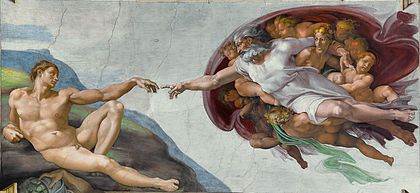
The opening capacity of the Book of Genesis provide a mythic history of the infiltration of evil into the world.[5] God places the commencement man and adult female (Adam and Eve) in his Garden of Eden, from whence they are expelled; the first murder follows, and God's conclusion to destroy the world and salvage only the righteous Noah and his sons; a new humanity then descends from these and spreads throughout the world, simply although the new globe is as sinful as the former, God has resolved never once again to destroy the globe past flood, and the History ends with Terah, the father of Abraham, from whom will descend God's called people, the Israelites.[6] Neither Adam nor Eve is mentioned elsewhere in the Hebrew scriptures autonomously from a single listing of Adam in a genealogy in one Chronicles ane:1,[7] suggesting that although their story came to be prefixed to the Jewish story, information technology has piffling in common with information technology.[viii]
Creation narrative [edit]
Adam and Eve are the Bible's first man and commencement adult female.[9] [ten] Adam'due south name appears first in Genesis one with a collective sense, equally "mankind"; later in Genesis 2–3 information technology carries the definite commodity ha, equivalent to English "the", indicating that this is "the man".[9] In these chapters God fashions "the man" (ha adam) from earth (adamah), breathes life into his nostrils, and makes him a caretaker over creation.[9] God side by side creates for the man an ezer kenegdo, a "helper corresponding to him", from his side or rib.[10] The word "rib" is a pun in Sumerian, as the word ti means both "rib" and "life".[xi] [12] She is called ishsha, "adult female", because, the text says, she is formed from ish, "man".[ten] The man receives her with joy, and the reader is told that from this moment a human will get out his parents to "cling" to a woman, the 2 becoming one flesh.[10]
The Fall [edit]
The start man and adult female are in God's Garden of Eden, where all cosmos is vegetarian and there is no violence. They are permitted to eat the fruits of all the copse except one, the tree of the knowledge of practiced and evil. The woman is tempted by a talking serpent to eat the forbidden fruit, and gives some to the homo, who eats likewise.[x] (Contrary to popular myth she does non beguile the man, who appears to have been nowadays at the come across with the serpent).[10] God curses all 3, the homo to a lifetime of difficult labour followed by death, the woman to the pain of childbirth and to subordination to her husband, and the serpent to go on his belly and suffer the enmity of both man and woman.[10] God then wearing apparel the nakedness of the man and adult female, who accept go god-like in knowing good and evil, and then banishes them from the garden lest they swallow the fruit of a 2d tree, the tree of life, and alive forever.[13]
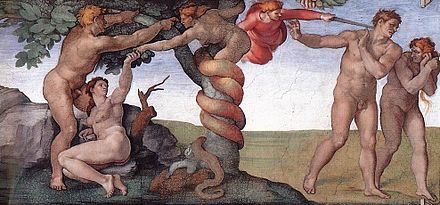
The Fall of Adam and Eve as depicted on the Sistine Chapel ceiling
Expulsion from Eden [edit]
The story continues in Genesis 3 with the "expulsion from Eden" narrative. A course assay of Genesis 3 reveals that this portion of the story can be characterized every bit a parable or "wisdom tale" in the wisdom tradition. The poetic addresses of the chapter belong to a speculative type of wisdom that questions the paradoxes and harsh realities of life. This characterization is determined by the narrative's format, settings, and the plot. The course of Genesis 3 is as well shaped by its vocabulary, making use of various puns and double entendres.[14]
The expulsion from Eden narrative begins with a dialogue betwixt the woman and a ophidian,[15] identified in Genesis 3:one as an animal that was more crafty than whatever other creature fabricated by God, although Genesis does not place the ophidian with Satan.[16] The adult female is willing to talk to the serpent and answer to the fauna's cynicism by repeating God's prohibition against eating fruit from the tree of cognition (Genesis 2:17).[17] The adult female is lured into dialogue on the serpent'due south terms which directly disputes God's control.[eighteen] The snake assures the adult female that God will not let her die if she ate the fruit, and, furthermore, that if she ate the fruit, her "eyes would be opened" and she would "be like God, knowing skillful and evil" (Genesis 3:5). The woman sees that the fruit of the tree of knowledge is a delight to the eye and that it would be desirable to acquire wisdom by eating the fruit. The woman eats the fruit and gives some to the man (Genesis three:6). With this the homo and adult female recognize their own nakedness, and they make loincloths of fig leaves (Genesis three:7).[nineteen]
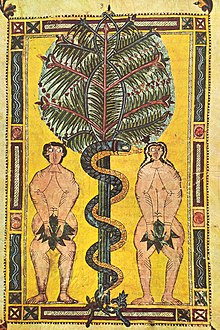
Adam and Eve in an illuminated manuscript (c. 950)
In the side by side narrative dialogue, God questions the homo and the woman (Genesis three:viii–13),[15] and God initiates a dialogue by calling out to the man with a rhetorical question designed to consider his wrongdoing. The man explains that he hid in the garden out of fearfulness because he realized his own nakedness (Genesis 3:x).[20] This is followed by two more than rhetorical questions designed to show awareness of a disobedience of God'due south control. The man then points to the woman as the existent offender, and he implies that God is responsible for the tragedy because the woman was given to him by God (Genesis 3:12).[21] God challenges the woman to explain herself, and she shifts the blame to the serpent (Genesis three:thirteen).[22]
Divine pronouncement of three judgments are then laid confronting all the culprits, Genesis 3:fourteen–nineteen.[xv] A judgement oracle and the nature of the crime is first laid upon the serpent, then the woman, and, finally, the human being. On the snake, God places a divine curse.[23] The woman receives penalties that impact her in ii master roles: she shall experience pangs during childbearing, hurting during childbirth, and while she shall want her hubby, he will dominion over her.[24] The human being's punishment results in God cursing the ground from which he came, and the man and then receives a death oracle, although the man has non been described, in the text, equally immortal.[16] : xviii, [25] Abruptly, in the flow of text, in Genesis three:20, the man names the adult female "Eve" (Heb. hawwah), "because she was the mother of all living". God makes pare garments for Adam and Eve (Genesis iii:20).
The chiasmus structure of the decease oracle given to Adam in Genesis 3:19, is a link between man'south creation from "dust" (Genesis 2:7) to the "return" of his ancestry:[26]" you return, to the basis, since from it you were taken, for dust you are, and to dust, you volition return."
The garden account ends with an intradivine monologue, determining the couple's expulsion, and the execution of that deliberation (Genesis three:22–24).[15] The reason given for the expulsion was to forestall the man from eating from the tree of life and condign immortal: "Behold, the man is become as ane of u.s.a., to know good and evil; and now, lest he put forth his hand, and have also of the tree of life, and eat, and alive for ever" (Genesis iii:22).[16] : 18, [27] God exiles Adam and Eve from the Garden and installs cherubs (supernatural beings that provide protection) and the "ever-turning sword" to guard the entrance (Genesis iii:24).[28]
Offspring [edit]
Genesis 4 narrates life exterior the garden, including the nascence of Adam and Eve's first children Cain and Abel and the story of the outset murder. A 3rd son, Seth, is born to Adam and Eve, and Adam had "other sons and daughters" (Genesis 5:4). Genesis v lists Adam's descendants from Seth to Noah with their ages at the nascency of their starting time sons and their ages at expiry. Adam's age at death is given equally 930 years. According to the Volume of Jubilees, Cain married his sister Awan, a daughter of Adam and Eve.[29]
Textual history [edit]
The Primeval History forms the opening capacity of the Torah, the five books making upwards the history of the origins of Israel. This achieved something like its electric current form in the 5th century BCE,[30] but Genesis i–11 shows little relationship to the rest of the Bible:[31] for example, the names of its characters and its geography – Adam (man) and Eve (life), the Country of Nod ("Wandering"), then on – are symbolic rather than real,[32] and nigh none of the persons, places and stories mentioned in it are ever met anywhere else.[32] This has led scholars to suppose that the History forms a belatedly composition fastened to Genesis and the Pentateuch to serve as an introduction.[33] Just how late is a bailiwick for debate: at one extreme are those who meet it every bit a product of the Hellenistic period, in which case it cannot be before than the kickoff decades of the 4th century BCE;[34] on the other hand the Yahwist source has been dated by some scholars, notably John Van Seters, to the exilic pre-Persian period (the 6th century BCE) precisely because the Earliest History contains so much Babylonian influence in the form of myth.[35] [Notation i] The Primeval History draws on two singled-out "sources", the Priestly source and what is sometimes chosen the Yahwist source and sometimes simply the "non-Priestly"; for the purpose of discussing Adam and Eve in the Book of Genesis the terms "non-Priestly" and "Yahwist" can be regarded every bit interchangeable.[36]
Abrahamic traditions [edit]
Judaism [edit]
It was likewise recognized in aboriginal Judaism that in that location are two singled-out accounts for the creation of human. The first account says "male and female [God] created them", implying simultaneous creation, whereas the 2nd account states that God created Eve subsequent to the creation of Adam. The Midrash Rabbah – Genesis VIII:1 reconciled the two by stating that Genesis i, "male and female He created them", indicates that God originally created Adam as a hermaphrodite,[37] bodily and spiritually both male person and female, before creating the separate beings of Adam and Eve. Other rabbis suggested that Eve and the adult female of the first business relationship were two separate individuals, the beginning being identified equally Lilith, a figure elsewhere described as a night demon.
According to traditional Jewish belief, Adam and Eve are buried in the Cave of Machpelah, in Hebron.
In Genesis 2:7 "God breathes into the man's nostrils and he becomes nefesh hayya", signifying something similar the English word "being", in the sense of a corporeal body capable of life; the concept of a "soul" in the modern sense, did not exist in Hebrew thought until around the 2nd century BC, when the idea of a actual resurrection gained popularity.[38]
Christianity [edit]
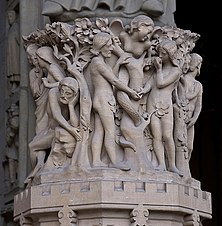
Some early fathers of the Christian church held Eve responsible for the Autumn of human being and all subsequent women to be the starting time sinners because Eve tempted Adam to commit the taboo. "You lot are the devil's gateway" Tertullian told his female readers, and went on to explain that they were responsible for the death of Christ: "On account of your desert [i.eastward., punishment for sin, that is, death], even the Son of God had to die."[39] In 1486, the Dominicans Kramer and Sprengler used like tracts in Malleus Maleficarum ("Hammer of Witches") to justify the persecution of "witches".
Medieval Christian art ofttimes depicted the Edenic Serpent as a woman (often identified as Lilith), thus both emphasizing the serpent's seductiveness too as its human relationship to Eve. Several early Church Fathers, including Clement of Alexandria and Eusebius of Caesarea, interpreted the Hebrew "Heva" as not but the proper name of Eve, only in its aspirated course every bit "female snake."
Based on the Christian doctrine of the Autumn of man, came the doctrine of original sin. St Augustine of Hippo (354–430), working with a Latin translation of the Epistle to the Romans, interpreted the Campaigner Paul as having said that Adam's sin was hereditary: "Death passed upon [i.e., spread to] all men because of Adam, [in whom] all sinned", Romans 5:12 [40] Original sin became a concept that man is born into a condition of sinfulness and must look redemption. This doctrine became a cornerstone of Western Christian theological tradition, however, non shared past Judaism or the Orthodox churches.
Over the centuries, a system of unique Christian behavior had developed from these doctrines. Baptism became understood as a washing abroad of the stain of hereditary sin in many churches, although its original symbolism was apparently rebirth. Additionally, the serpent that tempted Eve was interpreted to have been Satan, or that Satan was using a serpent equally a mouthpiece, although there is no mention of this identification in the Torah and it is not held in Judaism.
Regarding the real beingness of the progenitors – as of other narratives contained in Genesis – the Catholic Church teaches that Adam and Eve were historical humans, personally responsible for the original sin. This position was clarified by Pope Pius XII in the encyclical Humani Generis, in which the Pope condemned the theory of polygenism and expressed that original sin comes "from a sin actually committed by an individual Adam".[41]
Gnostic traditions [edit]
Gnostic Christianity discussed Adam and Eve in 2 known surviving texts, namely the "Apocalypse of Adam" found in the Nag Hammadi documents and the Testament of Adam. The creation of Adam every bit Protoanthropos, the original man, is the focal concept of these writings.
Some other Gnostic tradition held that Adam and Eve were created to help defeat Satan. The ophidian, instead of being identified with Satan, is seen as a hero past the Ophites. Still other Gnostics believed that Satan's fall, however, came after the creation of humanity. As in Islamic tradition, this story says that Satan refused to bow to Adam due to pride. Satan said that Adam was inferior to him as he was made of fire, whereas Adam was made of clay. This refusal led to the fall of Satan recorded in works such as the Book of Enoch.
In Mandaeism, "(God) created all the worlds, formed the soul through his power, and placed information technology past means of angels into the man body. Then He created Adam and Eve, the first man and adult female."[42]
Islam [edit]

Painting from Manafi al-Hayawan (The Useful Animals), depicting Adam and Eve. From Maragheh in Iran, 1294–99
In Islam, Adam ( Ādam ; Arabic: آدم), whose function is being the father of humanity, is looked upon by Muslims with reverence. Eve ( Ḥawwāʼ ; Arabic: حواء ) is the "mother of humanity".[43] The creation of Adam and Eve is referred to in the Qurʼān , although different Qurʼanic interpreters give different views on the actual cosmos story (Qurʼan, Surat al-Nisaʼ, verse 1).[44]
In al-Qummi'south tafsir on the Garden of Eden, such place was not entirely earthly. According to the Qurʼān , both Adam and Eve ate the forbidden fruit in a Heavenly Eden. Equally a outcome, they were both sent downward to Earth as God's representatives. Each person was sent to a mountain peak: Adam on al-Safa, and Eve on al-Marwah. In this Islamic tradition, Adam wept 40 days until he repented, after which God sent downward the Black Stone, teaching him the Hajj. According to a prophetic hadith, Adam and Eve reunited in the plain of ʻArafat, almost Mecca.[45] They had two sons together, Qabil and Habil. In that location is too a legend of a younger son, named Rocail, who created a palace and sepulcher containing autonomous statues that lived out the lives of men so realistically they were mistaken for having souls.[46]
The concept of "original sin" does non be in Islam because, according to Islam, Adam and Eve were forgiven by God. When God orders the angels to bow to Adam, Iblīs questioned, "Why should I bow to human? I am made of pure burn and he is made of soil."[47] The liberal movements inside Islam have viewed God's commanding the angels to bow earlier Adam as an exaltation of humanity, and as a means of supporting homo rights; others view it equally an deed of showing Adam that the biggest enemy of humans on earth will be their ego.[48]
In Swahili literature, Eve ate from the forbidden tree, thus causing her expulsion, after being tempted by Iblis. Thereupon, Adam heroically eats from the forbidden fruit in gild to follow Eve and protect her on world.[49]
Baháʼí Faith [edit]
In the Baháʼí Religion, Adam is regarded as the first Manifestation of God.[50] The Adam and Eve narrative is seen as symbolic. In Some Answered Questions, 'Abdu'l-Bahá rejects a literal reading and states that the story contains "divine mysteries and universal meanings".[51] Adam symbolizes the "spirit of Adam", Eve symbolizes "His self", the Tree of Knowledge symbolizes "the material earth", and the snake symbolizes "attachment to the cloth globe".[52] [53] [54] The fall of Adam thus represents the fashion humanity became witting of skilful and evil.[l] In another sense, Adam and Eve represent God's Volition and Conclusion, the showtime ii of the seven stages of Divine Creative Action.[55]
Historicity [edit]
While a traditional view was that the Book of Genesis was authored by Moses and has been considered historical and metaphorical, modern scholars consider the Genesis creation narrative as one of various ancient origin myths.[56] [57]
Analysis like the documentary hypothesis as well suggests that the text is a consequence of the compilation of multiple previous traditions, explaining apparent contradictions.[58] [59] Other stories of the same canonical book, similar the Genesis flood narrative, are too understood as having been influenced by older literature, with parallels in the older Ballsy of Gilgamesh.[60]
With scientific developments in paleontology, biology, genetics and other disciplines, information technology was discovered that humans, and all other living things, share a common ancestor and evolved through natural processes, over billions of years to diversify into the life forms we know today.[61] [62]
In biology the most recent mutual ancestors of humans, when traced back using the Y-chromosome for the male lineage and mitochondrial Dna for the female lineage, are commonly called the Y-chromosomal Adam and Mitochondrial Eve, respectively. These do not fork from a single couple at the same epoch even if the names were borrowed from the Tanakh.[63]
Arts and literature [edit]
John Milton'due south Paradise Lost, a famous 17th-century epic poem written in blank poesy, explores and elaborates upon the story of Adam and Eve in keen detail. As opposed to the biblical Adam, Milton's Adam is given a glimpse of the future of flesh, by the archangel Michael, before he has to leave Paradise.
Mark Twain wrote humorous and satirical diaries for Adam and Eve in both "Eve's Diary" (1906) and The Individual Life of Adam and Eve (1931), posthumously published.
C. 50. Moore's 1940 story Fruit of Cognition is a re-telling of the Fall of Human being as a dearest triangle betwixt Lilith, Adam and Eve – with Eve'due south eating the forbidden fruit beingness in this version the result of misguided manipulations past the jealous Lilith, who had hoped to go her rival discredited and destroyed by God and thus regain Adam's honey.
In Stephen Schwartz's 1991 musical Children of Eden, "Father" (God) creates Adam and Eve at the same fourth dimension and considers them his children. They even assist Him in naming the animals. When Eve is tempted by the serpent and eats the forbidden fruit, Male parent makes Adam choose betwixt Him and Eden, or Eve. Adam chooses Eve and eats the fruit, causing Father to blackball them into the wilderness and destroying the Tree of Knowledge, from which Adam carves a staff. Eve gives birth to Cain and Abel, and Adam forbids his children from going beyond the waterfall in hopes Male parent will forgive them and bring them dorsum to Eden. When Cain and Abel grow upward, Cain breaks his hope and goes beyond the waterfall, finding the behemothic stones made past other humans, which he brings the family to see, and Adam reveals his discovery from the by: during their infancy, he discovered these humans, but had kept information technology underground. He tries to prevent Cain from seeking them out, which causes Cain to become enraged and he tries to assault Adam, simply instead turns his rage to Abel when he tries to stop him and kills him. Later, when an elderly Eve tries to speak to Father, she tells how Adam continually looked for Cain, and after many years, he dies and is cached underneath the waterfall. Eve besides gave birth to Seth, which expanded hers and Adam'due south generations. Finally, Male parent speaks to her to bring her home. Before she dies, she gives her blessings to all her futurity generations, and passes Adam's staff to Seth. Father embraces Eve and she also reunited with Adam and Abel. Smaller casts usually take the actors cast as Adam and Eve double as Noah and Mama Noah.

In Ray Nelson's novel Blake's Progress the poet William Blake and his wife Kate travel to the end of time where the demonic Urizen offers them his own re-estimation of the Biblical story: "In this painting you see Adam and Eve listening to the wisdom of their good friend and adviser, the ophidian. Ane might even say he was their Savior. He gave them freedom, and he would take given them eternal life if he'd been immune to."[ citation needed ]
John William "Uncle Jack" Dey painted Adam and Eve Leave Eden (1973), using stripes and dabs of pure color to evoke Eden's lush surround.[64]
In C.Due south. Lewis' 1943 science fiction novel Perelandra, the story of Adam and Eve is re-enacted on the planet Venus – only with a different ending. A green-skinned pair, who are destined to be the ancestors of Venusian humanity, are living in naked innocence on wonderful floating islands which are the Venusian Eden; a demonically-possessed Earth scientist arrives in a spaceship, acting the part of the serpent and trying to tempt the Venusian Eve into disobeying God; but the protagonist, Cambridge scholar Ransom, succeeds in thwarting him, and so that Venusian humanity volition have a glorious hereafter, costless of original sin.
Image gallery [edit]
-

-

-

Adam and Eve from a copy of the Falnama (Book of Omens) ascribed to Ja'far al-Sadiq, c. 1550, Safavid dynasty, Islamic republic of iran
-

Adam and Eve by Titian, c. 1550
-
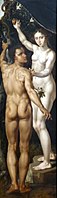
-
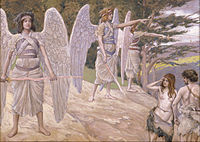
Adam and Eve Driven From Paradise by James Tissot, c. 1896-1902
-

Adam and Eve depicted in a mural in Abreha wa Atsbeha Church, Ethiopia
-
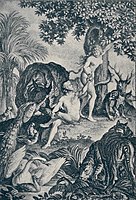
1896 illustration of Eve handing Adam the forbidden fruit
-
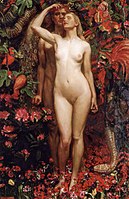
The Woman, the Human, and the Snake by Byam Shaw, 1911
See also [edit]
- Pre-Adamite
Notes [edit]
- ^ Encounter John Van Seters, Prologue to History: The Yahwist equally Historian in Genesis (1992), pp.lxxx, 155–156.
References [edit]
- ^ Womack, Mari (2005). Symbols and Meaning: A Concise Introduction. Walnut Creek ... [et al.]: Altamira Press. p. 81. ISBN978-0759103221 . Retrieved xvi August 2013.
Creation myths are symbolic stories describing how the universe and its inhabitants came to exist. Creation myths develop through oral traditions and therefore typically have multiple versions.
- ^ Leeming, David (2010). Cosmos Myths of the Globe: Parts I-II . p. 303.
- ^ Azra, Azyumardi (2009). "Affiliate 14. Trialogue of Abrahamic Faiths: Towards an Alliance of Civilizations". In Ma'oz, Moshe (ed.). The Meeting of Civilizations: Muslim, Christian, and Jewish. Eastbourne: Sussex Academic Printing. pp. 220–229. ISBN978-1-845-19395-ix.
- ^ Alfred J., Kolatch (1985). The Second Jewish Book of Why (2nd, revised ed.). New York Metropolis: Jonathan David Publishers. p. 64. ISBN978-0-824-60305-two. Excerpt in Judaism's Rejection Of Original Sin.
- ^ Blenkinsopp 2011, p. ix.
- ^ Blenkinsopp 2011, p. 1.
- ^ Enns 2012, p. 84.
- ^ Blenkinsopp 2011, p. iii.
- ^ a b c Hearne 1990, p. ix.
- ^ a b c d east f g Galambush 2000, p. 436.
- ^ Kramer 1963, p. 149.
- ^ Collon, Dominique (1995). Ancient Near Eastern Art. University of California Printing. p. 213. ISBN9780520203075 . Retrieved 27 April 2019.
the foreign story of Adam's 'spare rib' from which Eve was created (Genesis ii:xx-3) makes perfect sense once information technology is realised that in Sumerian the feminine particle and the words for rib and life are all ti, and then that the tale in its original form must accept been based on Sumerian puns.
- ^ Modify 2004, p. 27-28.
- ^ Freedman, Meyers, Patrick (1983). Carol L. Meyers; Michael Patrick O'Connor; David Noel Freedman (eds.). The Word of the Lord Shall Get Forth: Essays in Award of David Noel Freedman. Eisenbrauns. pp. 343–344. ISBN9780931464195.
- ^ a b c d Mathews 1996, p. 226
- ^ a b c Levenson, Jon D. (2004). "Genesis: Introduction and Annotations". In Berlin, Adele; Brettler, Marc Zvi (eds.). The Jewish Written report Bible . Oxford University Press. ISBN9780195297515.
The Jewish report Bible.
- ^ Mathews 1996, p. 235
- ^ Mathews 1996, p. 236
- ^ Mathews 1996, p. 237
- ^ Mathews 1996, p. 240
- ^ Mathews 1996, p. 241
- ^ Mathews 1996, p. 242
- ^ Mathews 1996, p. 243
- ^ Mathews 1996, p. 248
- ^ Mathews 1996, p. 252
- ^ Mathews 1996, p. 253
- ^ Addis, Edward (1893). The Documents of the Hexateuch, Volume one. Putnam. pp. 4–seven.
- ^ Weinstein, Brian (2010). 54 Torah Talks: From Layperson to Layperson. iUniverse. p. 4. ISBN9781440192555.
- ^ Betsy Halpern Amaru (1999). The Empowerment of Women in the Volume of Jubilees, p. 17.
- ^ Enns 2012, p. v.
- ^ Sailhamer 2010, p. 301 and fn.35.
- ^ a b Blenkinsopp 2011, p. 2.
- ^ Sailhamer 2010, p. 301.
- ^ Gmirkin 2006, p. 240-241.
- ^ Gmirkin 2006, p. six.
- ^ Carr 2000, p. 492.
- ^ Howard Schwartz (September 2004). Tree of Souls: The Mythology of Judaism: The Mythology of Judaism. p. 138. ISBN978-0195086799 . Retrieved 27 Dec 2014.
The myth of Adam the Hermaphrodite grows out of three biblical verses
- ^ Harry Orlinsky's Notes to the NJPS Torah
- ^ "Tertullian, "De Cultu Feminarum", Book I Chapter I, Modesty in Clothes Becoming to Women in Memory of the Introduction of Sin Through a Woman (in "The Dues-Nicene Fathers")". Tertullian.org. Retrieved 2014-02-17 .
- ^ Fox, Robin Lane (2006) [1991]. The Unauthorized Version: Truth and Fiction in the Bible. Penguin Books Limited. pp. 15–27. ISBN9780141925752.
- ^ "Humani Generis (August 12, 1950) | PIUS XII". www.vatican.va . Retrieved 2020-11-17 .
- ^ Al-Saadi, Qais (27 September 2014), "Ginza Rabba "The Great Treasure" The Holy Volume of the Mandaeans in English", Mandaean Associations Union , retrieved 28 Nov 2021
- ^ Historical Lexicon of Prophets in Islam and Judaism, Wheeler, "Adam and Eve"
- ^ Quran 4:1:O mankind! Be dutiful to your Lord, Who created you lot from a unmarried person (Adam), and from him (Adam) He created his wife Hawwa (Eve), and from them both He created many men and women;
- ^ Wheeler, Brannon (July 2006). Mecca and Eden: Ritual, Relics, and Territory in Islam – Brannon M. Wheeler – Google Books. p. 85. ISBN9780226888040 . Retrieved 17 February 2014.
- ^ Godwin, William (1876). Lives of the Necromancers. Chatto and Windus. pp. 112–113. Retrieved 29 January 2019.
- ^ Quran 7:12
- ^ Javed Ahmed Ghamidi, Mizan. Lahore: Dar al-Ishraq, 2001
- ^ John Renard Islam and the Heroic Image: Themes in Literature and the Visual Arts Mercer Academy Printing 1999 ISBN 9780865546400 p. 122
- ^ a b Smith, Peter (2000). "Adam". A Concise Encyclopedia of the Baháʼí Faith. London: Oneworld Publications. ISBN978-one-78074-480-3. OCLC 890982216. Retrieved 2021-06-26 – via Google Books.
- ^ Sours, Michael (2001). The Tablet of the Holy Mariner: An Illustrated Guide to Baha'u'llah's Mystical Work in the Sufi Tradition. Los Angeles: Kalimát Press. p. 86. ISBN978-1-890688-19-6.
- ^ ʻAbdu'50-Bahá (2014) [1908]. Some Answered Questions (newly revised. ed.). Haifa, Israel: Baháʼí World Heart. ISBN978-0-87743-374-three.
- ^ Momen, Wendy (1989). A Basic Baháʼí Dictionary. Oxford, United kingdom: George Ronald. p. viii. ISBN978-0-85398-231-ix.
- ^ McLean, Jack (1997). Revisioning the Sacred: New Perspectives on a Baháʼí Theology – Volume 8. p. 215.
- ^ Saiedi, Nader (2008). Gate of the Heart. Waterloo, ON: Wilfrid Laurier University Press. p. 204. ISBN978-ane-55458-035-4.
- ^ Van Seters, John (1998). "The Pentateuch". In Steven L. McKenzie, Matt Patrick Graham (ed.). The Hebrew Bible Today: An Introduction to Critical Issues. Westminster John Knox Press. p. 5. ISBN9780664256524.
- ^ Davies, M.I (1998). "Introduction to the Pentateuch". In John Barton (ed.). Oxford Bible Commentary. Oxford University Press. p. 37. ISBN9780198755005.
- ^ Gooder, Paula (2000). The Pentateuch: A Story of Ancestry. T&T Clark. pp. 12–fourteen. ISBN9780567084187.
- ^ Van Seters, John (2004). The Pentateuch: A Social-scientific discipline Commentary. Continuum International Publishing Group. pp. thirty–86. ISBN9780567080882.
- ^ Finkel, Irving (2014). The Ark Earlier Noah. UK: Hachette. p. 88. ISBN9781444757071.
- ^ Kampourakis, Kostas (2014). Understanding Evolution. Cambridge; New York: Cambridge University Press. pp. 127–129. ISBN978-1-107-03491-iv. LCCN 2013034917. OCLC 855585457.
- ^ Schopf, J. William; Kudryavtsev, Anatoliy B.; Czaja, Andrew D.; Tripathi, Abhishek B. (Oct 5, 2007). "Evidence of Archean life: Stromatolites and microfossils". Precambrian Research. 158 (3–iv): 141–155. Bibcode:2007PreR..158..141S. doi:10.1016/j.precamres.2007.04.009. ISSN 0301-9268.
- ^ Takahata, N (January 1993). "Allelic genealogy and human evolution". Mol. Biol. Evol. 10 (1): 2–22. doi:10.1093/oxfordjournals.molbev.a039995. PMID 8450756.
- ^ "Adam and Eve Leave Eden". Smithsonian American Art Museum . Retrieved 11 February 2014.
Bibliography [edit]
- Almond, Philip C. Adam and Eve in Seventeenth-Century Thought (Cambridge: Cambridge Academy Press, 1999, 2008)
- Change, Robert (2004). The 5 Books of Moses. W. W. Norton & Company. ISBN978-0-393-33393-0.
- Ayoub, Mahmoud. The Qur'an and its Interpreters, SUNY: Albany, 1984
- Blenkinsopp, Joseph (2011). Creation, Un-creation, Re-creation: A Discursive Commentary on Genesis ane–11. A&C Black. ISBN978-0-567-37287-ane.
- Carr, David M. (2000). "Genesis, Volume of". In Freedman, David Noel; Myers, Allen C. (eds.). Eerdmans Lexicon of the Bible. Eerdmans. ISBN9789053565032.
- Enns, Peter (2012). The Development of Adam: What the Bible Does and Doesn't Say about Man Origins. Baker Books. ISBN978-1-58743-315-3.
- Galambush, Julie (2000). "Eve". In Freedman, David Noel; Myers, Allen C. (eds.). Eerdmans Dictionary of the Bible. Amsterdam University Press. ISBN9789053565032.
- Gmirkin, Russell (15 May 2006). Berossus and Genesis, Manetho and Exodus: Hellenistic Histories and the Date of the Pentateuch. Bloomsbury Publishing. ISBN978-0-567-13439-iv.
- Greenblatt, Stephen (2017). The Rise and Fall of Adam and Eve. New York: W. W. Norton. ISBN978-0-393-24080-i.
- Hearne, Stephen Z. (1990). "Adam". In Mills, Watson E.; Bullard, Roger Aubrey (eds.). Mercer Dictionary of the Bible. Mercer University Press. ISBN9780865543737.
- Hendel, Ronald S (2000). "Adam". In David Noel Freedman (ed.). Eerdmans Dictionary of the Bible. Amsterdam University Press. ISBN9789053565032.
- Kissling, Paul (2004). Genesis, Volume 1. College Press. ISBN978-0899008752.
- Kramer, Samuel Noah (1963). The Sumerians: Their History, Civilisation, and Graphic symbol . University of Chicago Press. ISBN0-226-45238-vii.
- Mathews, K. A. (1996). Genesis 1–11:26. B&H Publishing Group. ISBN978-0805401011.
- Mckenzie, John L. (1995). The Dictionary of the Bible. Simon and Schuster. ISBN9780684819136.
- Murdoch, Brian O. The Apocryphal Adam and Eve in Medieval Europe: Vernacular Translations and Adaptations of the Vita Adae et Evae. Oxford University Press, 2009. ISBN 978-0-19-956414-ix
- Patai, R. The Jewish Alchemists, Princeton University Press, 1994.
- Rana & Hugh. Fazale Rana and Ross, Hugh, Who Was Adam: A Cosmos Model Approach to the Origin of Homo, 2005, ISBN 1-57683-577-4
- Sailhamer, John H. (21 December 2010). Introduction to Old Testament Theology: A Canonical Arroyo. Zondervan Academic. ISBN978-0-310-87721-9.
- Sykes, Bryan. The Vii Daughters of Eve
External links [edit]
- First Human Beings (Library of Congress)
- The Story of Lilith in The Alphabet of Ben Sira
- Islamic view of the fall of Adam (sound)
- 98 classical images of Adam and Eve
- The Book of Jubilees
- Adam and Eve in Medieval Reliefs, Capitals, Frescoes, Roof Bosses and Mosaics Cynistory and Phantamangas of Finceland
- "Adam and Eve" at the Christian Iconography website
- Translation of Grimm's Fairy Tale No. 180, Eve'southward Unequal Children, a German language Fairy Tale most Adam and Eve
- Jewish Encyclopedia
Source: https://en.wikipedia.org/wiki/Adam_and_Eve

Post a Comment for "Will the Lord Allowed His Children to See the Garden of Eden Again"