Whats the Best Way to Scan Your Art and Then Print
I wanted to share some tips with y'all all virtually how I create scans/pictures of my fine art and edit them in Photoshop. Below I walk y'all through the entire process I utilise to prepare my images to brand loftier quality prints. Don't forget to Share, Tweet or Pivot this commodity if you detect it helpful!
Photographing Your Fine art
Almost of my art is also big or awkward for my A4 scanner, so I photograph it with my Nikon Coolpix P7800. Pretty much any digital photographic camera volition practise equally long as you make sure to set it to the highest quality & resolution. This amazing video by Tyler Stalman & Jason Eng created for Saatchi Online explains perfectly how to take good pictures of your art.
Using a tripod (or another fashion to stabilise your camera) is essential. I attach my artwork to the wall with Blu Tack or pic hanging strips. I use a spirit level to ensure information technology is completely straight. I also brand sure my tripod is leveled and the camera is straight. The more than authentic you can be about this, the less yous will take to 'ready' in Photoshop in terms of distorting the picture to go far fit.
I have a window on the left side of the wall which throws light, so I employ a simple soft box light pointing at the painting from the right. You lot are trying to attain equal soft lighting on the whole painting, no directly harsh low-cal or shadows.
Using manual focus if your photographic camera allows information technology is helpful. Nothing is more abrasive than loading the pictures onto your reckoner only to find that they are not in focus or non everything is in equal focus.
Scanning Your Art
If your art is relatively apartment and fits on your scanner it is preferable to utilize this method. Y'all won't be at the mercy of varying lighting conditions and a scanner volition go bang-up detail and equally will be in focus.
Before scanning ensure the resolution is set to 300ppi. Depending on your scanner you may need to adjust the effulgence and contrast. From the signal of view of being able to adjust later in Photoshop, I prefer a scan that is slightly on the dark side over one that is as well calorie-free. Adjust the brightness & contrast sliders and keep previewing until the preview matches the colours, detail & contrast of the original artwork. If yous can, salvage these settings as a new contour and so you tin can quickly admission them next time.

On the left the default scanner settings, on the right with brightness & contrast adapted. The adjusted scan is much more true to the original artwork. The default loses a lot of item past being too bright and the colours are washed out.
Adjusting Your Fine art In Photoshop
I use Photoshop CS2, merely any programme that allows yous to adjust these settings will practise. Editing in Photoshop is specially good for when you've photographed your art.
First I want to straighten up my art piece and brand sure it fills up the whole canvas. I utilize the Rectangular Marquee tool to select every bit close around the artwork as I tin, without cutting any of information technology off. Then I crop the image (Image > Crop). This may mean that on some sides the groundwork still shows. To gear up that, I utilize the Transform tool (Ctrl+T), and right click on the epitome and select Skew. I then drag the corners out where necessary. If yous demand to rotate your canvas with the transform tool (you shouldn't have to if yous followed the steps for straightening the artwork on the wall and leveling your tripod – it'southward really worth doing!) do that earlier skewing.
Now we brand the magic happen. Kickoff go to Paradigm > Adjustments > Auto Levels. If it looks good, proceed information technology. If it looks "WHOA TOO MUCH!" you can fade the effect by going to Edit > Fade Auto Levels and select a percentage. Then go to Image > Adjustments > Auto Contrast. Fade again if needed. Finally nosotros use Image > Adjustments > Auto Color (and Fade).
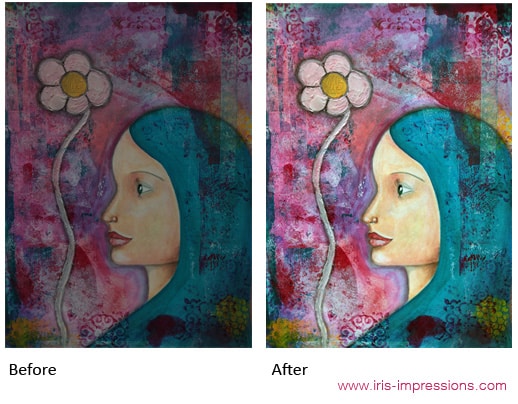
How much y'all use these three tools depends on how true to life the pictures/scans you took are. Sometimes I hardly need to modify anything, other times information technology makes a huge deviation.
Save your moving picture at a high setting. I tend to go for File > Save Every bit and so select jpg at Quality 12. There are other file types with less compression, but I've found there is no visually noticeable data loss with this setting and it keeps file sizes manageable.
Voila!
Now yous've got your hi-res digital master to make prints of forevermore, even if you lot sell the original!
If you follow this tutorial delight let me know in the comments, I'd love to know how you lot got on. If yous have any questions I'll be happy to answer them!
Source: https://iris-impressions.com/how-to-photographscan-your-art-and-prepare-it-for-high-quality-art-prints/

Post a Comment for "Whats the Best Way to Scan Your Art and Then Print"